The Inner Compass Assessment
A clinical assessment that uncovers the source of your attachment style and translates it into precision solutions to rewire your relationships.
See Your Operating System → Immediate access · $79 · No sales callMost relationship assessments are flat. They produce a label. Anxious-avoidant. Pursuer-distancer. Type 4. The Inner Compass descends. Five layers down through nervous system, narrative, and identity. At the bottom is the original developmental need that fires the whole sequence. The descent has a name: MAPSS. Mind → Attribution → Perspective → Sentiment → Story.
Each layer is grounded in a separate body of research. The integration is what's proprietary. The layers are not.
Karl Friston's predictive processing model (2010, refined throughout the 2020s) describes the nervous system as a prediction machine, scanning for confirmation of what it already believes about threat and safety. Daniel Kahneman's System 1 (Thinking, Fast and Slow, 2011) is the cognitive economy that makes the scan run in milliseconds. The reaction you experience as instinct is the output of a model that was calibrated before you could name it.
What couples fight about is rarely what's actually underneath. Sue Johnson's Emotionally Focused Therapy (Hold Me Tight, 2008; The Practice of Emotionally Focused Couple Therapy, 2012) demonstrates that the secondary emotion (anger, contempt, defensiveness, withdrawal) is the visible layer of a protective stack with primary attachment emotion underneath. Christensen and Heavey's demand-withdraw research (1990s onward, with three decades of replication) anchors the interactional pattern this layer produces. The Attribution layer surfaces both the meaning the brain wrote and the reactive emotion that fires with it.
Richard Schwartz's Internal Family Systems model (Internal Family Systems Therapy, 1995; IFS Skills Training Manual, 2018) maps the protector, manager, firefighter, and exile structure that activates under perceived threat. Each protector earned its job in development. The fight in the room is not between two people. It is between two protectors meeting each other, both running ancient code. The Perspective layer names the hardened vantage point so it can stop being identity and start being information.
Stephen Porges' polyvagal theory (The Polyvagal Theory, 2011) maps three nervous system states: ventral vagal (safe and social), sympathetic (mobilized for fight or flight), and dorsal vagal (collapsed, frozen, shut down). The Sentiment layer pairs the primary affect (fear, grief, shame, helplessness) with the autonomic substrate that holds it. Bessel van der Kolk's The Body Keeps the Score (2014) supplies the longitudinal evidence that this layer runs the show whether the conscious mind acknowledges it or not.
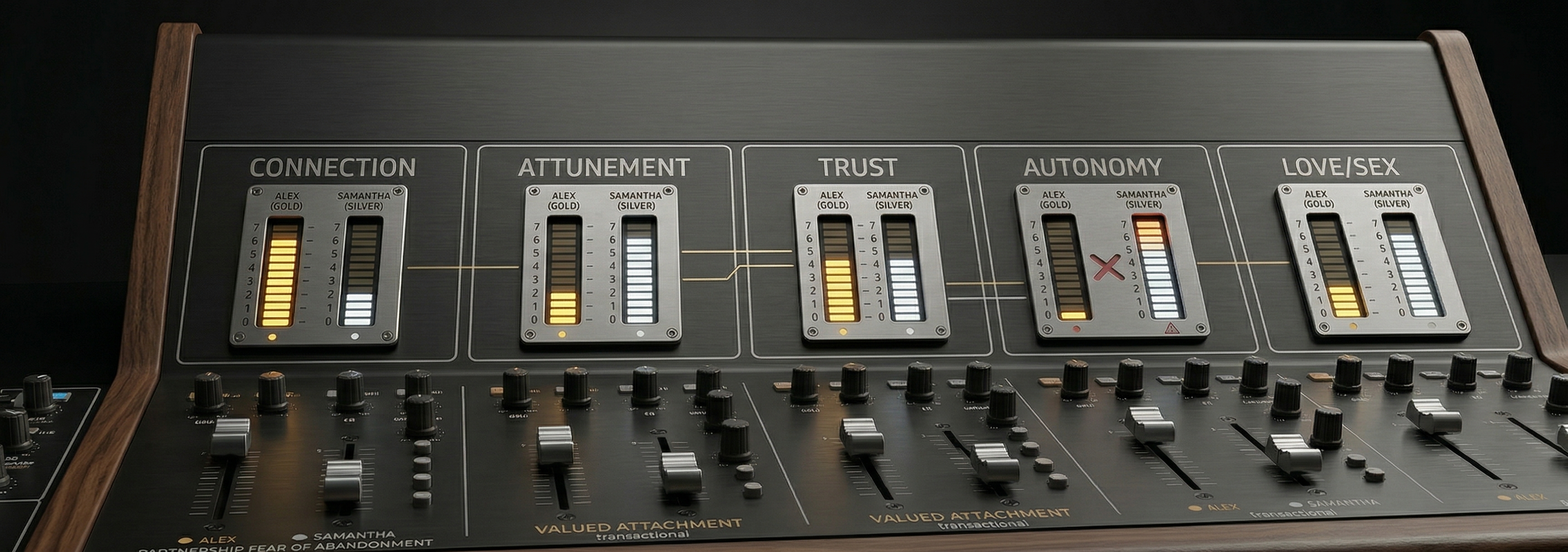
Laurence Heller's NeuroAffective Relational Model (Healing Developmental Trauma, 2012) identifies five core organizing needs that wound early in development: Connection, Attunement, Trust, Autonomy, and Love & Sexuality. Bowlby and Ainsworth's attachment research (1960s–70s), extended through Mikulincer and Shaver's adult attachment work (Attachment in Adulthood, 2007), supplies the relational template the wounding gets organized around. Dan McAdams' narrative identity research (The Stories We Live By, 1993) names the chapter-writing function the mind runs on top. The Story layer reaches the source code.
A symptom checklist produces a label. The Inner Compass produces a clinical descent and a matched intervention path. For each MAPSS layer the report names the body cue, the protective part, the developmental anchor, and a specific re-authoring move. For couples, two descents converge into a single map of the cycle, with mirror-and-mission moves for each partner at each layer.
The output is not a diagnosis. It is a map of the nervous system that built the strategies, the strategies that built the patterns, and the patterns that show up in the relationship.
The work is naming the architecture clearly enough that what was running automatically can become something the person chooses.
Frameworks integrated: Friston predictive processing · Kahneman dual-process cognition · Johnson EFT · Christensen demand-withdraw · Schwartz IFS · Porges polyvagal · van der Kolk somatic trauma · Heller NARM · Bowlby-Ainsworth-Mikulincer-Shaver attachment · McAdams narrative identity · Bowen differentiation · Funk-Rogge CSI · Skowron-Schmitt DSI-R.
You've done the work.
You've read the books.
You understand your patterns.
And yet they're still running.
Your partner's tone shifts.
The defensiveness rises before you can catch it.
They go quiet.
Your brain starts scanning for what you did wrong.
You get feedback.
Instead of hearing it, you shut down.
The worst part isn't the reaction. It's what comes after. The shame. The overthinking. The voice that says, "I thought I healed this. Why do I keep doing this?"
Every reaction you can't explain, every fight that starts before you realize it, every wall that goes up when you want it down. That is not a character flaw. That's your nervous system running a program it wrote when you were too young to choose.
It runs automatically. It runs fast. And it won't change just because you understand it.
That's why the Inner Compass doesn't ask you to try harder. It shows you the system. Then gives you the tools to change it.
"Anxiously attached" is not a diagnosis. It's a bumper sticker.
The Inner Compass finds the system, maps the loop, and gives you a plan matched to your wiring.
Layer One
Not a type. Not a label. A plain-language belief system operating underneath your behavior. Anchored in peer-reviewed research. The Inner Compass is built on NARM (the NeuroAffective Relational Model), a clinical framework for developmental trauma that maps how your brain organized itself around five core needs: Connection, Attunement, Trust, Autonomy, and Love & Sexuality. We take that science and put it in language you can actually use.
Something like: "If I let my guard down, I'll get hurt." Or: "I have to manage everything or it all falls apart." Most people have never seen their survival driver stated this clearly.
Layer Two
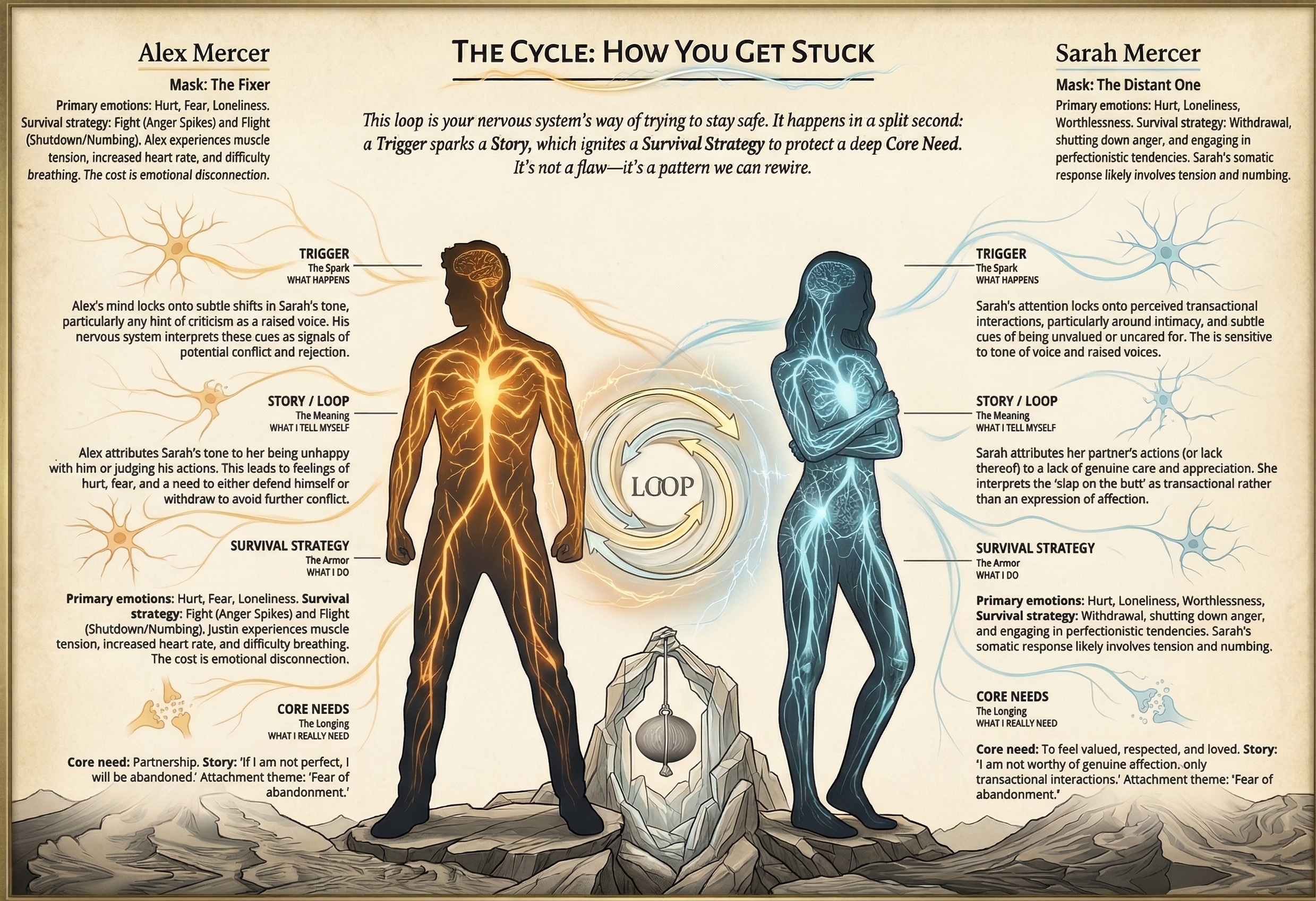
The trigger. The story your brain creates. The protector strategy you default to. And what it's costing you. Instead of guessing why you react the way you do, you see the entire sequence laid out.
This produces the most immediate response. The moment you see your own system mapped with precision.
Layer Three
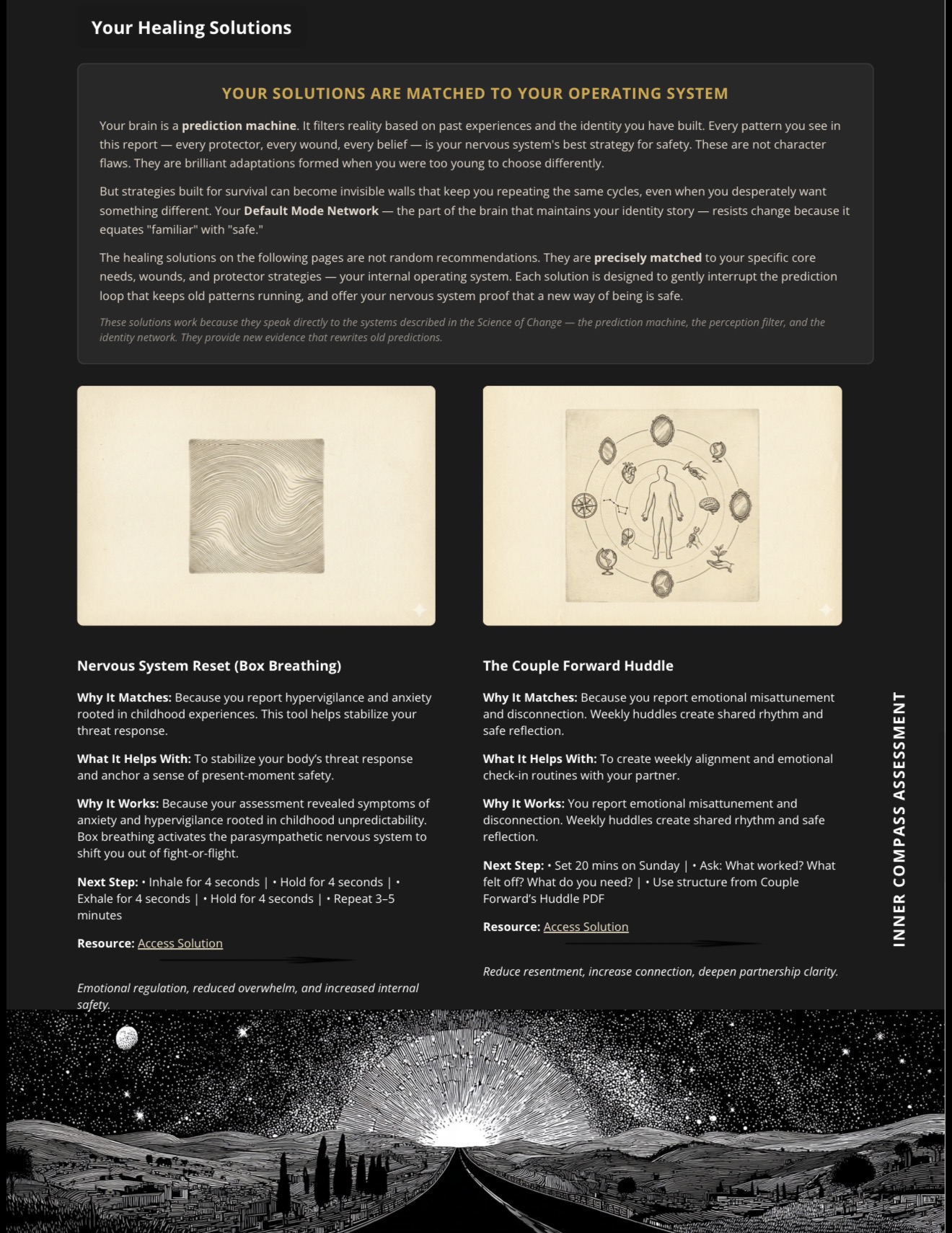
If your pattern is hypervigilance, you get nervous system reset protocols designed for that. If your pattern is shutdown, you get targeted regulation and expression scripts. Plus a Liberation Guide and a structured framework for ongoing rewiring.
Every solution is tied to your specific operating system. Not a generic reading list.
If that sounds like what you've been looking for.
Begin Your Assessment →One couple came in stuck in the same fight on repeat. He was hyper-independent, managing everything to prevent her anxiety from escalating. She was conflict-avoidant, shutting down the moment his tone shifted.
Underneath: fear, frustration, and a longing for partnership that his own fixing was blocking. His nervous system had learned that managing everything was the only way to stay safe.
Underneath: loneliness and a longing for safety that her silence was preventing. Her system treated withdrawal as the only available protection.
Neither one was the problem. The loop was the problem. And neither could see it until it was mapped.
They used the matched repair phrases, the weekly rituals, and the mask replacement protocols. Within weeks, clients report reduced hypervigilance, increased vulnerability, and fewer shutdown cycles.
And in the most resistant case, where only one partner did the assessment, the person who did the work shifted so visibly that the skeptic eventually opted into the Couples Upgrade on their own.
"Felt like someone finally translated our fights into English. The Inner Compass didn't just point out problems. It showed me why my nervous system reacts the way it does and what healing would actually look like. Then the Couples Report mapped our loop and gave us clear moves to interrupt it. Real direction, fast."— Dave & Sally P.
"I went in skeptical. I've done years of therapy. But seeing my survival driver written out. The exact belief running underneath everything. It stopped me cold. That alone was worth it."— Rachel M.
"I already know my patterns. I don't need another assessment."
Knowing you're anxiously attached doesn't tell you that your nervous system scans for threat before you're aware of a thought. It doesn't show you that your brain treats each unexamined reaction as evidence the old story is correct, reinforcing the wiring every time. You don't need more information. You need to see your operating system.
"Can't I just work on this myself?"
You've been reading the books and journaling. And you're still here because the patterns haven't changed. That's not a discipline problem. It's because insight alone doesn't rewire your nervous system. Your brain runs its survival algorithm before conscious thought arrives. Insight without structured intervention is expensive self-awareness.
"What if my partner won't do it?"
This works as an individual assessment. You don't need your partner to participate. In fact, many people take it solo. The shift in their own patterns is visible enough that their partner eventually asks to take it too. Change in one nervous system changes the dynamic for both.
"Psychology is long on problems and short on solutions. My aim is an assessment that reveals the source code of each couple's patterns and links them to the correct solutions, so they can actually change their life and relationships."
— Christian J. Charette, LMFT
Two Individual Compass Roadmaps
One Couples Report
See the pattern you've never been able to name. Your full report maps the hidden belief driving your reactions, the protective mask you wear, and the exact loop that plays out every time you get triggered. In plain language.
Get tools that actually work for your brain. Not a generic checklist. Targeted exercises chosen because your assessment shows you need them. Calm your nervous system, break shame spirals, and start responding instead of reacting.
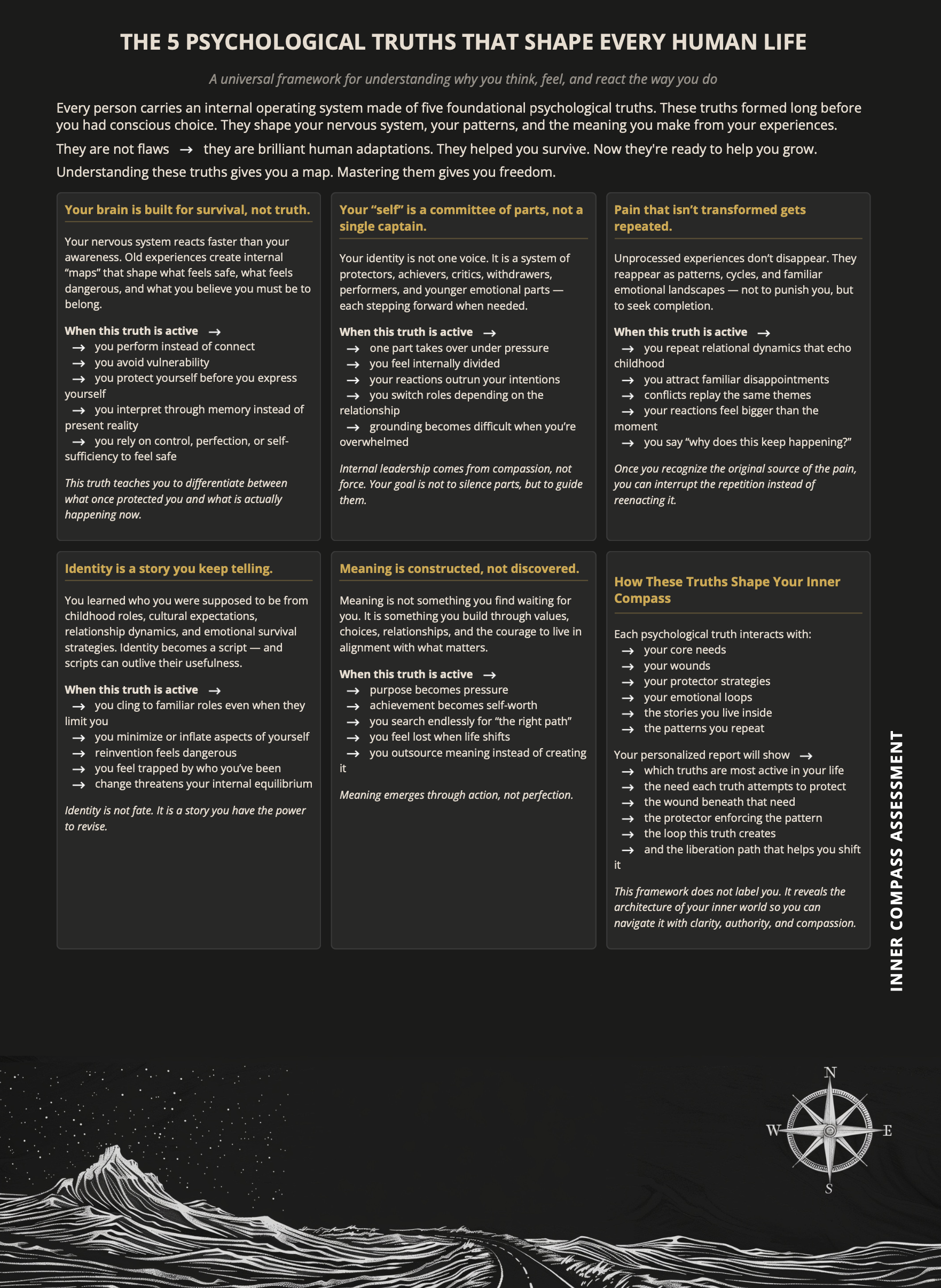
Understand what's really driving you. Your 5 Truths Profile reveals the deeper forces shaping your relationships. Which one runs your life, and how they push and pull against each other.
Start breaking the loop today. Your Liberation Guide gives you daily practices matched to your specific pattern. Small shifts that prove to your nervous system that a new way of being is safe.
Rewire on autopilot. 12 personalized affirmations you record in your own voice, plus a playlist built for your brain. Listen while you drive, cook, or walk. Your nervous system takes it in without you having to add another task.
Your partner takes their own assessment. Then you both get The Way Forward Report. Your cycle mapped together, showing why you keep getting stuck in the same fight. Plus exact phrases to repair in the moment and a weekly ritual to rebuild connection.
Immediate access. No sales call. No waiting list.
Get Your Assessment →Your nervous system ran the loop today.
It will run it again tomorrow.
See your Inner Compass. See what's driving you.
Carl Jung said, "Until you make the unconscious conscious, it will direct your life and you will call it fate." Building on this, until you radically accept that The Map Is Not the Territory, real intimacy will escape you within and without, and you call that fate too.
— Christian J. Charette, LMFT